
Chicago Probate Court Records
Probate court records in Chicago are filed and stored at the Cook County Circuit Clerk's office in the Richard J. Daley Center downtown. The Probate Division on the 12th floor handles all estate, guardianship, and will cases for Chicago residents. With over 2.7 million people, Chicago generates a large share of the probate filings in Cook County each year. You can search these records online through the Circuit Clerk's case portal or visit the courthouse in person to get copies. This page covers the steps for finding, searching, and getting probate court records in Chicago.
Chicago Probate Court Records Quick Facts
Chicago Probate Court Records Office
The Probate Division of the Cook County Circuit Court sits at 50 W. Washington St., Room 1202, Chicago, IL 60602. This is the sole office where Chicago probate court records are kept and managed. Circuit Clerk Mariyana T. Spyropoulos runs the office that processes all probate filings for Cook County, which includes every neighborhood in Chicago. The division hears cases that deal with wills, estates of people who have died, adult guardianship matters, and minor estate cases. Staff break the caseload into three main groups: decedent estates, adult guardianship estates, and minor estates.
You can reach the Probate Division at (312) 603-7546 for questions about a case or how to file. The general Circuit Clerk line is (312) 603-5030. For procedural questions, contact Joseph Fleming at (312) 603-7546 or by email at joseph.fleming@cookcountyil.gov. The Circuit Clerk Probate Division page has hours, forms, and filing instructions that apply to all Chicago probate court records.
Under the Illinois Probate Act (755 ILCS 5), the Circuit Court has full power to admit wills, appoint estate representatives, and settle estates. Chicago follows the same state rules as every other city in Illinois. The Probate Act sets out who can file, what forms are needed, and how the court handles each type of case. Cook County adds its own local procedures on top of these state rules, so the filing process in Chicago can differ slightly from what you see in smaller Illinois counties.
Search Probate Court Records Online
Cook County runs an online case search tool that covers all Chicago probate court records. The online case information portal lets you look up cases by party name or case number. Results show docket data, including filing dates, case types, party names, and court dates. Keep in mind that this portal shows docket information only. It does not give you the full documents. To get copies of the actual filings, you need to visit the Clerk's office or send a written request.
Probate cases in Chicago use a case number format that starts with a year and a "P" prefix. If you know when the case was filed, use that year to narrow your search. The system pulls up a list of matches, and you can click through to see more detail on each one. The portal is free to use and does not need an account.
For questions about the online system, email the Circuit Clerk's support team. Joseph Fleming handles most procedural questions about probate court records in Chicago and is the best point of contact for anything the online portal does not answer.
Probate Court Records Case Types
The most common Chicago probate court records are decedent estate cases. When a Chicago resident dies, a family member or lawyer files a petition with the Probate Division to open the estate. The court then appoints an executor or administrator to handle the estate's affairs. All documents filed from that point become part of the probate court records for that case. These include the petition, will (if there is one), inventory of assets, claims by creditors, and the final accounting. The Probate Act (755 ILCS 5) spells out how each step works. Public access is the default. Anyone can request copies.
Adult guardianship cases are the second largest group. A petition asks the court to appoint a guardian for someone who can no longer make their own decisions due to illness or disability. The court file holds medical reports, the petition itself, and all orders the judge issues. These records are public, though some medical details may be restricted. Minor estate cases round out the three main types. They involve assets held for a child, often from an inheritance or a lawsuit settlement. The Probate Division page on the Cook County Court website explains each case type in more detail.
The screenshot below shows the court's page about probate case types in Cook County.
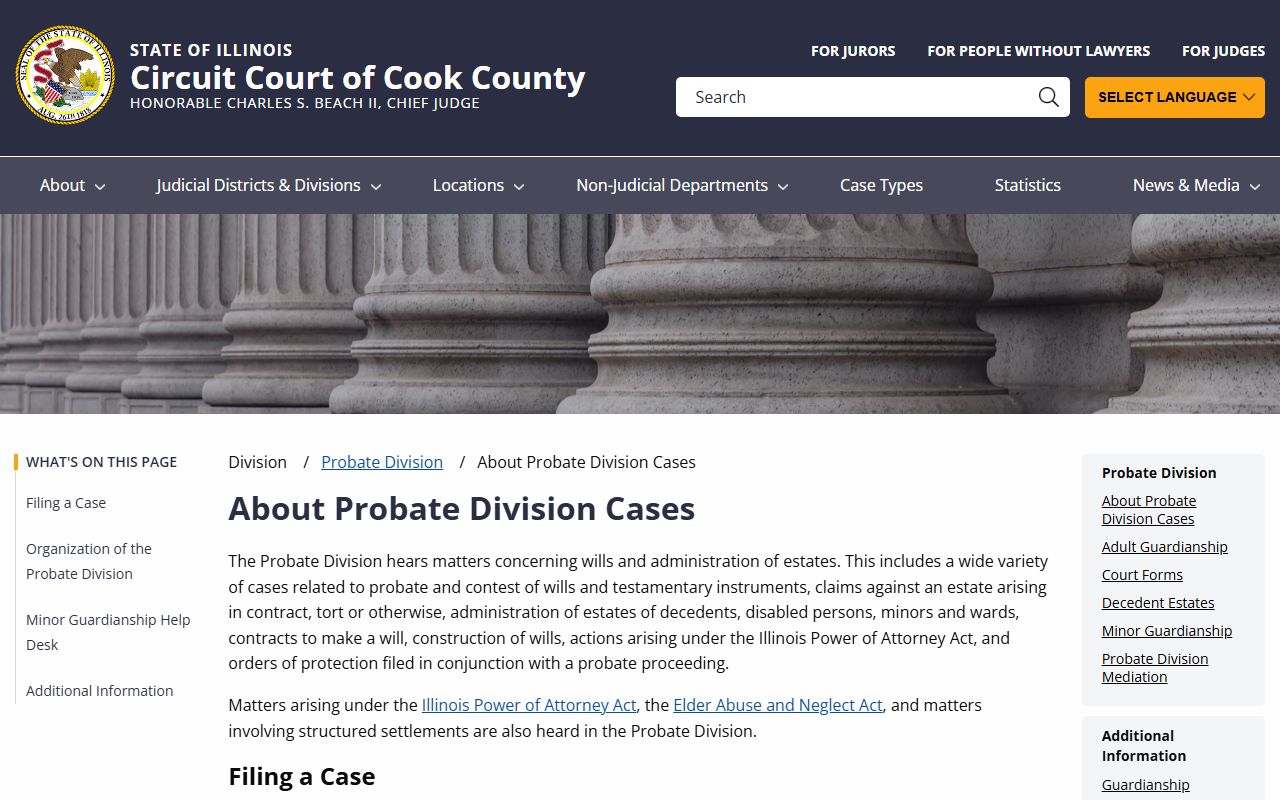
That page covers what to expect when your case goes before a judge and how hearings are scheduled in the Probate Division.
Filing Probate Court Records
Chicago requires electronic filing for most court documents. This rule covers probate cases too. Lawyers and people who file on their own use the eFileIL portal to submit petitions, motions, and other paperwork. Once a document goes through the system, it becomes part of the official probate court records for that case. The filing shows up in the Clerk's database right away and becomes searchable through the online portal.
Some items still need to go in by hand. Original wills must be filed as physical documents at the Clerk's office on the 12th floor of the Daley Center. There is no fee to file a will for safekeeping in Cook County. You bring the original will to the office, staff process it, and it gets entered into the system. Certain sealed filings also need to be submitted in person. The Circuit Clerk's office has a self-help center that can walk you through the process if you are not sure which forms to use or how to file them.
E-filing has sped things up quite a bit. Documents show up in the court's records the same day in most cases. Before the switch to electronic filing, paper submissions in Cook County could take days to process given the sheer volume of probate court records the office handles.
Probate Court Records Fees
The Cook County Circuit Clerk charges set fees for copies of probate court records. A regular copy is $2.00 for the first page. Pages 2 through 20 cost $0.50 each. Pages after page 20 cost $0.25 each. Letters of Office, which prove that a person has been named to handle an estate, cost $2.00 per copy. Filing a will for safekeeping is free. These fees apply to all Chicago probate court records.
Filing fees for new probate cases vary by case type. A standard estate administration petition has a fee that depends on estate size, as set under the Illinois Probate Act (755 ILCS 5) and related fee statutes. Small estate affidavits may carry lower fees. Guardianship petitions have their own schedule. Call the Clerk's office at (312) 603-5030 to get the exact fee for your filing type. Fees can change, so the numbers listed here reflect the most recent published schedule.
You can pay at the courthouse with cash, check, or money order. Credit cards may work for some transactions. For documents filed through eFileIL, the system collects fees at the time you submit.
How to Get Copies
There are three ways to get copies of Chicago probate court records. The most direct is to visit the Circuit Clerk's office in person at 50 W. Washington St., Room 1202. Bring the case number or the full name of the person whose records you need. Staff will pull the file and make copies. The office is open Monday through Friday during standard court hours. Try to arrive early because the Probate Division can get busy, especially in the morning when the most people show up.
The second option is mail. Send a letter to the Circuit Clerk of Cook County at 50 W. Washington St., Suite 1001, Chicago, IL 60602. Include the party name, case number if you have it, and a clear note about which documents you want. Add a check or money order for the copy fees. The Clerk will process the request and mail the copies back to you. Allow extra time for delivery and processing. Mail requests for probate court records can take a week or more to come back.
Third, you can view docket data online through the case portal. The portal does not provide full document downloads for most records. If you need the actual court filings, an in-person or mail request is the way to go.
Contact for Probate Court Records
The Circuit Clerk contact page has the full list of phone numbers, email addresses, and office locations for the Cook County Clerk of Court.
Here is the key info for Chicago probate court records:
- Probate Division: (312) 603-7546
- General Clerk Line: (312) 603-5030
- Address: 50 W. Washington St., Room 1202, Chicago, IL 60602
- Probate Contact: Joseph Fleming, joseph.fleming@cookcountyil.gov
- Website: cookcountyclerkofcourt.org
Call ahead to check hours before you visit. The Probate Division follows standard Cook County court hours but may close on holidays and during special court events.
Legal Help in Chicago
If you need help with a probate case, the Illinois State Bar Association runs a lawyer referral service. You can connect with a Chicago attorney who handles estate and probate law. Many offer a low-cost first meeting. The Cook County Circuit Court also has a self-help center for people filing probate cases without a lawyer. Staff there can point you to the right forms and explain basic steps, though they can not give legal advice.
The Illinois Courts approved forms page has standard probate forms that work in Cook County and across the state. You can download and print them for free. The Cook County Court Probate Division page provides background on the types of cases the division hears and what documents end up in the court file. For help getting copies of your records, the Illinois Legal Aid guide walks through the full process, including what forms to use and fees to expect.
Cook County Probate Court Records
Chicago sits in Cook County. All probate court records for Chicago residents are filed at the Cook County Circuit Clerk's office. Visit the full Cook County guide for more detail on the Probate Division, fee schedules, and courthouse info.
Nearby Cities
These cities near Chicago also have probate court records guides. Most are in Cook County and use the same Probate Division. A few border other counties, so check each guide for the right filing location.